Why Mass AI Content Kills Organic SEO (And Caused Your Traffic Drop)

Google does not penalise content simply because an artificial intelligence tool wrote it. Search algorithms filter out redundant, substitutable commodity content that fails to provide new value to searchers.
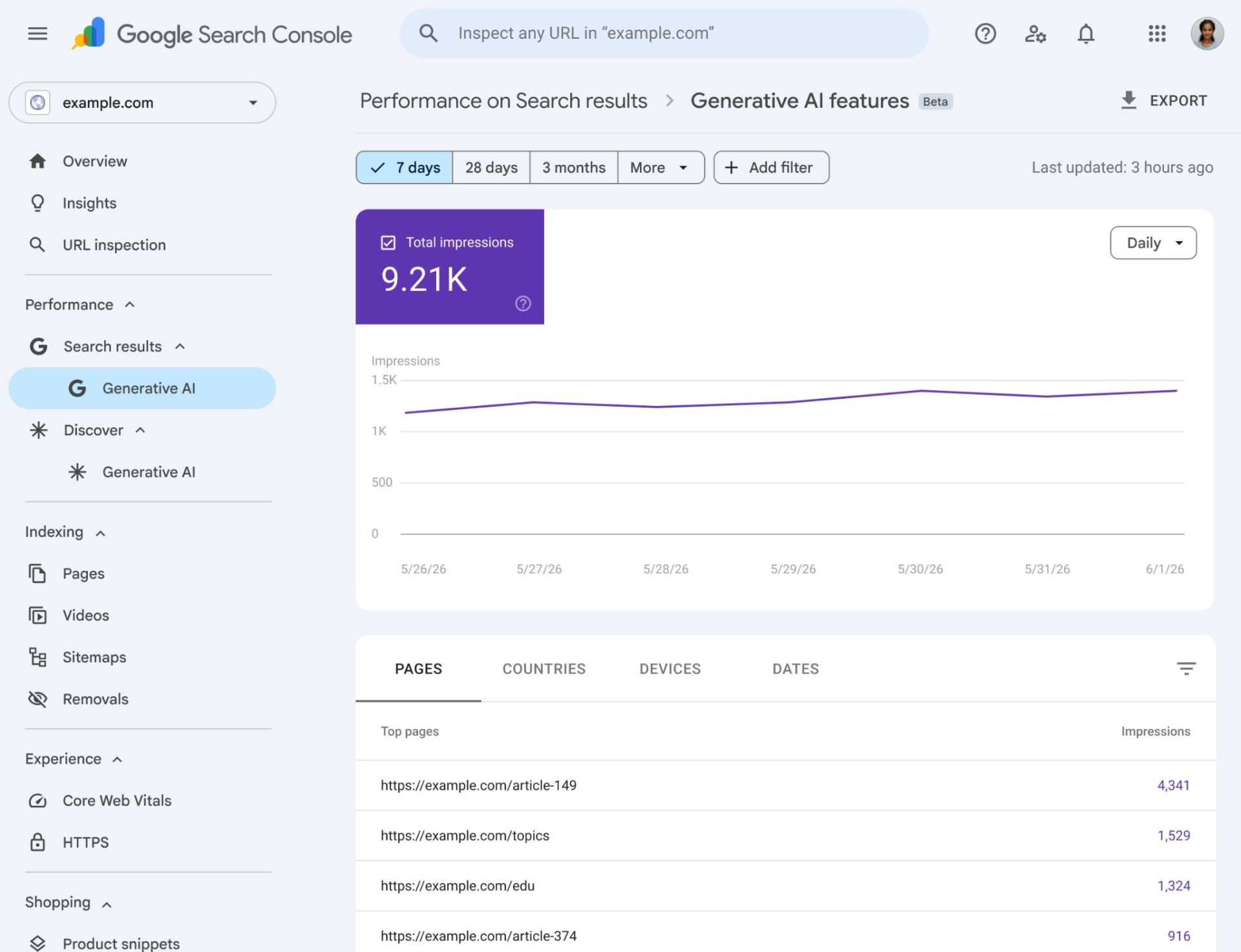
If your business scaled article output using raw generative AI prompts, only to watch organic search traffic stagnate or see key URLs flagged as “Crawled – currently not indexed” in Google Search Console, you are experiencing the AI hangover. The fix is not abandoning automation. The solution is shifting from unedited mass generation to a human-led, AI-accelerated workflow grounded in Information Gain.
The Myth of the “AI Penalty” (What Google Actually Cares About)
A widespread misconception among business owners is that search engines maintain automated detectors to penalise AI-written text. Google’s official guidance confirms that automation is not inherently against search guidelines unless used primarily as a spam mechanism to manipulate rankings.
At an industry conference in Toronto, Google Search Liaison Danny Sullivan explained that generative AI tools lowered the technical barrier to producing content at scale. Because publishing millions of near-identical articles became trivial, Google raised the bar for what gets indexed and ranked.
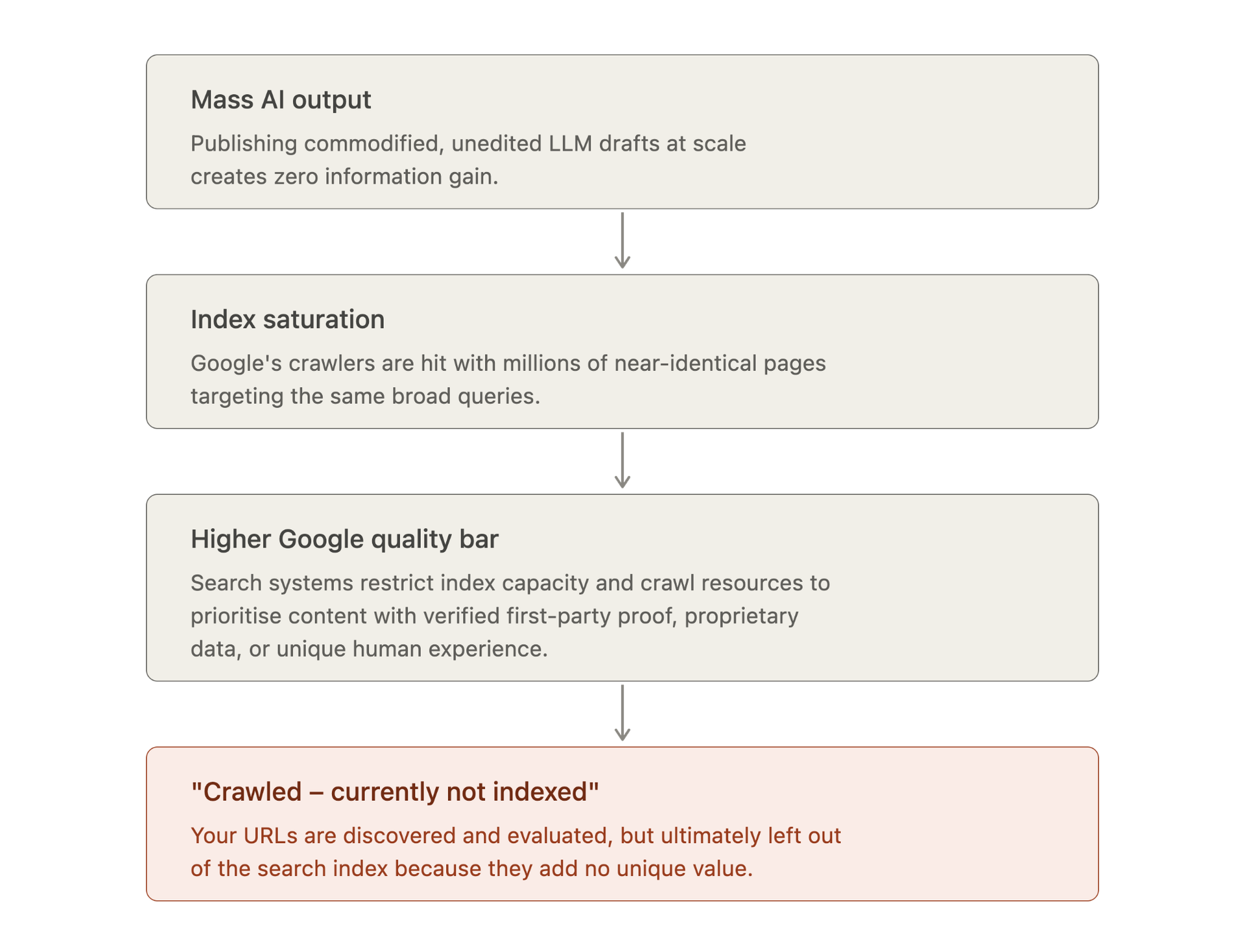
This quality threshold is driven by Google’s Information Gain system, detailed in Patent US20200349181A1. When generative AI floods search engines with near-identical summaries, Google assigns a lower Information Gain score to duplicate URLs, leaving them in ‘Crawled – currently not indexed’ status.
Search engines calculate a numerical Information Gain score (from 0.00 to 1.00) by comparing a candidate page against documents the user has already viewed or that already rank for the query. If a newly published article merely paraphrases existing search results without adding novel facts, proprietary data, or unique framing, its score drops toward 0.00. Google then demotes the URL or excludes it from the index entirely.
Why Mass-Produced AI Content Fails Google’s Search Filters
When businesses prompt raw Large Language Models (LLMs) to write full blog posts, the resulting drafts default to commodity content. Because LLMs operate by predicting probable word sequences based on existing web data, their unguided output produces an aggregated average of top-ranking pages.
According to search performance data and Google’s documentation, unedited AI drafts fail across four distinct areas:
- Lack of Originality: Raw AI rewrites existing web pages, adding duplicate information and search noise without introducing new perspectives.
- Factual Errors and Hallucinations: Generative tools can invent statistics, incorrect facts, and broken references, directly violating Google’s E-E-A-T (Experience, Expertise, Authoritativeness, and Trustworthiness) standards.
- Poor User Engagement: Emotionless, generic text leads to high bounce rates and short dwell times as readers realize the page lacks real-world substance.
- Mass Publishing Risks: Pumping out dozens of unedited drafts triggers algorithmic de-indexing filters designed to protect search result quality.
In 5 Twelve’s foundational breakdown of Commodity vs. Non-Commodity Content, content uniqueness is evaluated using a 5-criterion Substitution Test:
SubstitutionScore=Insight+Specificity+Stake+Replicability+Proof
Articles scoring between 0 and 3 points fall into the commodity tier, making them vulnerable to indexing suppression and ranking drops.
The Hybrid AI Workflow: Using AI as an Accelerant, Not a Replacement
To protect your organic search visibility in an AI-saturated market, your content team must adopt a “data-first, AI-second” hybrid workflow. The rule of thumb is straightforward: automation handles structural formatting and drafting efficiency (roughly 30% of the execution), while your internal subject-matter experts supply the primary data, commercial stance, and real-world proof (70% of the strategic value).
| Workflow Stage | Primary Responsibility | Core Deliverables / Tasks | Strategic Purpose |
| Stage 1: Human Input*(The Foundation)* | Subject-Matter Expert (SME) | • Subject-Matter Extraction: Voice notes, unscripted answers to client edge cases.• Proprietary Data: Internal metrics, audit logs, real-world project results.• Unpopular Opinions: Contrarian takes that challenge generic industry advice. | Creates the non-commodity Information Gain that cannot be scraped, aggregated, or predicted by an LLM. |
| Stage 2: AI Acceleration*(The Engine)* | Generative AI / LLMs | • Structure & Outlining: Organising messy notes into logical heading hierarchies.• Transcript Synthesis: Cleaning spoken colloquialisms into coherent prose.• Drafting Skeletons: Generating transitions, formatting lists, and scaffolding paragraphs. | Eliminates drafting friction and accelerates production by 60%–70% without sacrificing strategic depth. |
| Stage 3: Human Polish*(The Gatekeeper)* | Senior Editor / Strategist | • Local Context & Tone: Adapting voice, vernacular, and regulatory accuracy (e.g., Australian/state-level nuance).• Proof Injection: Embedding screenshots, case citations, and raw data charts.• Substitution Test Audit: Running an operational pass to guarantee competitors cannot put their brand on the piece. | Guarantees quality, protects brand authority, and ensures the asset clears search engine indexing thresholds. |
Most marketing teams implement hybrid workflows backwards: they use humans to write prompts and rely on AI to do the thinking. At 5 Twelve, we invert that model entirely. Stage 1 extracts irreplaceable human evidence before software touches the screen. Stage 2 uses AI strictly as an organisational engine. Stage 3 audits the final draft against our Substitution Test to ensure no competitor could ever publish the same page.
Sample Case Scenario of a Property Investment Firm
To see how this process operates in practice, consider a property investment client that uses a carefully curated, fact-checked industry benchmark sheet as their internal “Source of Truth”.
Stage 1: Human Input (Curating the Source of Truth)
Instead of asking an AI tool to write an article from scratch, the client supplies a verified, proprietary dataset that no Large Language Model can scrape or guess from the open web:
- Source Asset: Q1 South East Queensland Property Benchmark Sheet (Fact-Checked Internal Data)
- Key Metric 1: Dual-occupancy residential yields in Logan reached a gross median of 6.2% (140 basis points above standard 4-bedroom houses).
- Key Metric 2: Regional vacancy rates held firm at 0.8% across managed portfolios.
- Key Metric 3: Average time-on-market for tenant placement: 9 days.
Stage 2: AI Acceleration (Structuring Without Hallucination)
The AI tool receives the Stage 1 data sheet as its strict reference context. Its role is limited to organising, synthesizing, and drafting a structured paragraph around these figures without inventing facts or adding generic fluff.
Stage 3: Human Polish (The Substitution Test Audit)
Before publication, a senior strategist reviews the draft against 5 Twelve’s 5-criterion Substitution Test. If a competitor or an AI generator could publish the same sentence without making it false, it fails the Information Gain threshold.
| Criterion | Snippet A (Commodity Content) | Snippet B (Non-Commodity Content) |
| Example Text | “Investing in Australian residential property is a proven strategy for building long-term wealth and passive rental income.” | “According to our verified Q1 South East Queensland Property Benchmark Sheet, dual-occupancy residential assets in Logan achieved a median gross rental yield of 6.2%, outperforming standard 4-bedroom houses by 140 basis points while maintaining a 0.8% vacancy rate.” |
| Primary Evidence | None. Relies on generic assertions without primary sources or verification. | High. Cites a verified, first-party dataset (Q1 South East Queensland Property Benchmark Sheet). |
| Regional Data | Absent. Uses broad, non-specific claims regarding Australian property. | Specific. Includes local metrics for Logan, dual-occupancy yield figures, and vacancy rates. |
| Commercial Insights | Generic. Offers no unique perspective or actionable market differentiation. | Proprietary. Delivers clear, impossible-to-substitute commercial analysis. |
| Substitution Test Score | 0/10 (Fails — easily substituted by any competitor) | 9/10 (Passes — unique to the firm publishing the data) |
How a Human-Led SEO Audit Diagnoses Your Content Strategy
If your website already contains dozens of automated AI posts, guessing which pages to update, merge, or remove can waste valuable time. While free online tools and automated software offer instant site checks, they produce generic, surface-level reports that fail to evaluate content substance, brand alignment, or Information Gain.
A professional, human-led SEO Audit provides a diagnostic review of your entire digital presence. Dedicated SEO specialists evaluate your content strategy alongside technical site health and user experience factors:
- Technical Crawlability & Indexing Review
- Content Quality & E-E-A-T Evaluation
- Information Gain & SERP Competitor Benchmarking
- Actionable, Prioritised Content Roadmap
By conducting a comprehensive team interview and analysing your Search Console performance data, a specialist audit identifies technical indexing blockers, flags thin commodity content, and provides a prioritised roadmap to align your pages with genuine commercial search intent.
Frequently Asked Questions About AI and Search
Does Google penalise AI-generated content?
No. Google’s Search guidance states that automation is not penalised unless used as a spam mechanism to manipulate rankings. Search algorithms evaluate page utility, factual accuracy, and E-E-A-T signals regardless of how the draft was authored.
What is the “30% rule” for AI in content creation?
The “30% rule” is an editorial workflow guideline suggesting AI tools should contribute no more than 30% of a finished piece (handling outlines, transcript cleaning, and initial structural drafting). The remaining 70% must come from human subject-matter expertise, local market context, and first-party proof.
Will AI eliminate organic SEO?
AI is not eliminating search engine optimisation; it is eliminating low-effort, repetitive publishing. As AI search interfaces summarise simple factual queries, organic search traffic flows increasingly to brands that publish original benchmarks, non-commodity insights, and distinct practitioner viewpoints.
Why are my pages marked “Crawled – currently not indexed” in Google Search Console?
This status indicates that Google discovered and crawled your URL but elected not to include it in the search index. This typically happens when search algorithms determine that the page fails Information Gain standards by duplicating information already available across competing top-ranking search results.
Turn Your Content Library into a Growth Engine
Publishing mass-produced commodity content is a positioning challenge disguised as an SEO issue. To compete in modern organic search, your digital library must balance top-of-funnel scaffolding pages with authoritative, non-commodity assets that earn backlinks, citations, and customer trust.
At 5 Twelve, we help Australian businesses replace generic publishing packages with transparent, data-driven search strategies. Whether you need an in-depth SEO Audit to fix existing indexing issues or an Ongoing SEO partnership to build long-term search authority, our Gold Coast team works directly alongside your staff without account managers or locked-in contracts.
Ready to evaluate your content library and build a load-bearing search strategy? Book a 60-minute Discovery Call with 5 Twelve today.