Practical eCommerce SEO Guide

eCommerce SEO is often presented as a simplified extension of “regular” SEO: optimise your product pages, write a few blogs, build some links, and wait for results.
In practice, that advice breaks down very quickly.
eCommerce websites are structurally more complex, commercially constrained, and operationally interdependent than most service-based sites. Decisions made by merchandising, developers, paid media teams, and even logistics can directly impact SEO performance.
Rather than offering a beginner checklist, this is a practical framework for eCommerce brands that want to use SEO as a revenue channel.
Why eCommerce SEO Is Harder Than Most Advice Admits
Most readily available SEO advice assumes:
- A small number of high-value pages
- Clear keyword-to-page mapping
- Stable URLs
- Minimal business evolution
eCommerce sites rarely meet any of those conditions.
Instead, they deal with:
- Hundreds or thousands of URLs generated by products, variants, filters, and pagination
- Constant inventory changes
- Seasonal demand swings
- Platform-imposed structural limitations
The result is that small technical or strategic mistakes compound quickly. A poorly handled filter system or weak category structure can affect hundreds. This is why many eCommerce brands “do SEO” for years without seeing meaningful revenue growth.
How eCommerce SEO Is Structurally Different From “Normal” SEO
1. Transactional intent dominates and is highly competitive
eCommerce users are typically much closer to a purchase decision. They are not looking to learn what a product is; they are looking to choose which one to buy. Searches driven by transactional intent are often the most competitive in the search landscape.
As a result:
- Google evaluates pages more heavily on commercial relevance, clarity, and usefulness
- Thin or vague content is less forgiving than in informational contexts
- UX, internal linking, and page structure play a larger role in ranking stability
A well-written blog post can rank with relatively little internal support. A category page competing for high-intent keywords cannot.
2. Category pages matter more than products
Product pages are volatile by nature. Products go out of stock, are discontinued, or change frequently. Categories, on the other hand, tend to persist over time.
From an SEO perspective:
- Categories accumulate authority through internal links, external links, and engagement signals
- They act as thematic hubs that contextualise product pages
- They are often the first point of entry for high-intent searchers
This is why optimising product pages in isolation rarely scales. Without strong category foundations, product visibility is fragile and short-lived.
For example, for an online fashion store, a product page for a specific dress may rank well temporarily, but once that dress sells out or is discontinued, its organic value disappears. A well-optimised “Women’s Dresses” or “Summer Dresses” category page, however, continues to attract high-intent searchers and provides a stable foundation that supports the visibility of every current and future product within it.
3. Duplication is unavoidable
Unlike most other website types, duplication in eCommerce is a structural reality.
Common sources include:
- Product variants (size, colour, material)
- Faceted navigation and filters
- Sorting parameters
- Pagination
- Similar or overlapping product ranges
Attempting to “remove” duplication entirely often creates more problems than it solves. The real challenge is controlling which versions of pages search engines prioritise, and which are de-emphasised.
Successful eCommerce SEO accepts duplication as inevitable and focuses instead on index control, canonical logic, and intent alignment.
4. Scale amplifies mistakes
On a small site, a misconfigured canonical tag or noindex rule may affect a handful of pages. On an eCommerce site, the same mistake can impact thousands.
Examples include:
- Canonicalising all filtered URLs incorrectly
- Blocking important categories through robots.txt
- Mishandling out-of-stock products at scale
- Introducing URL changes without proper redirects
These issues rarely cause immediate, obvious failures. Instead, they lead to gradual visibility erosion that is difficult to diagnose after the fact.
5. SEO must coexist with other priorities
Finally, eCommerce SEO rarely operates in isolation.
Merchandising, CRO, paid media, development, and inventory decisions all influence:
- URL structures
- internal linking
- content placement
- indexation behaviour
“Perfect SEO” that ignores commercial or operational realities is rarely implementable. The most effective strategies are those that work within real constraints, rather than fighting them.
Let’s Start With Platform & Architecture Decisions
SEO performance in eCommerce is heavily influenced by decisions made long before keyword research begins.
By the time keywords are being mapped or content is being written, many of the most impactful SEO outcomes have already been constrained by platform choice, URL logic, and site architecture decisions made during build or migration.
Every eCommerce platform introduces trade-offs. None are inherently “bad for SEO,” but each imposes structural rules that must be understood and worked within.
- Shopify simplifies management and scaling but limits URL customisation, collection logic, and native control over facets and parameters. SEO success on Shopify often depends on architectural discipline rather than flexibility.
- WooCommerce offers greater structural control but shifts responsibility onto configuration, hosting quality, and ongoing maintenance. Poor setups can introduce performance and duplication issues quickly.
- Custom platforms allow full control over URLs, taxonomy, and crawl logic, but require strong technical governance. Without it, SEO risk increases as complexity grows.
The platform itself is rarely the limiting factor. The real differentiator is whether its constraints are understood early and designed around, rather than patched later.
A strong eCommerce architecture typically prioritises:
- Shallow category depth, so priority pages are not buried several clicks from the homepage
- Clear parent-child relationships between categories, subcategories, and products
- Consistent internal linking paths that guide users and crawlers toward revenue-driving pages
And as we know, adding more copy to product pages will not compensate for categories competing with each other, products orphaned from internal linking, or even inconsistent URL structures across collections.
Effective eCommerce SEO starts by reducing structural friction, not increasing content output.
Category Page SEO: Your Primary Revenue Drivers
For most online stores, category and collection pages account for the largest share of organic revenue because they align directly with high-intent, non-branded search behaviour.
Users searching for “women’s dresses,” “linen bed sheets,” or “commercial kitchen equipment” are actively comparing options.
Google evaluates category pages across several core signals:
- Clear topical relevance: Does the page unambiguously represent a specific product set or intent?
- Internal linking strength: Is the category reinforced by links from navigation, subcategories, and supporting content?
- Content quality and placement: Is there enough contextual information to establish relevance without overwhelming the user?
- User engagement signals: Do users interact with products, refine their search, and move deeper into the site?
The challenge is that category pages sit at the intersection of SEO, UX, and conversion optimisation. Over-optimise for SEO, and the page becomes cluttered. Over-optimise for conversion, and the page becomes contextually thin.
A simple starting recipe for a balanced category page could look like:
- Clear category title (H1) that matches primary search intent (e.g. Women’s Dresses, not marketing slogans)
- Short introductory paragraph (50–100 words) that sets context, confirms relevance, and reassures users they are in the right place
- Visible product grid above the fold, prioritising usability and conversion first
- Logical subcategory links or filters that reflect how users naturally refine their search
- Scannable supporting content below the grid (where appropriate), using headings to reinforce secondary intent or common considerations
- Internal links to related categories or buying guides to support discovery and authority flow
- Clean pagination or infinite scroll handling, implemented consistently and crawl-safe
- Strong UX signals (fast load times, clear sorting, intuitive filters) that encourage engagement
- Consistent structured data and breadcrumbs to reinforce hierarchy and context
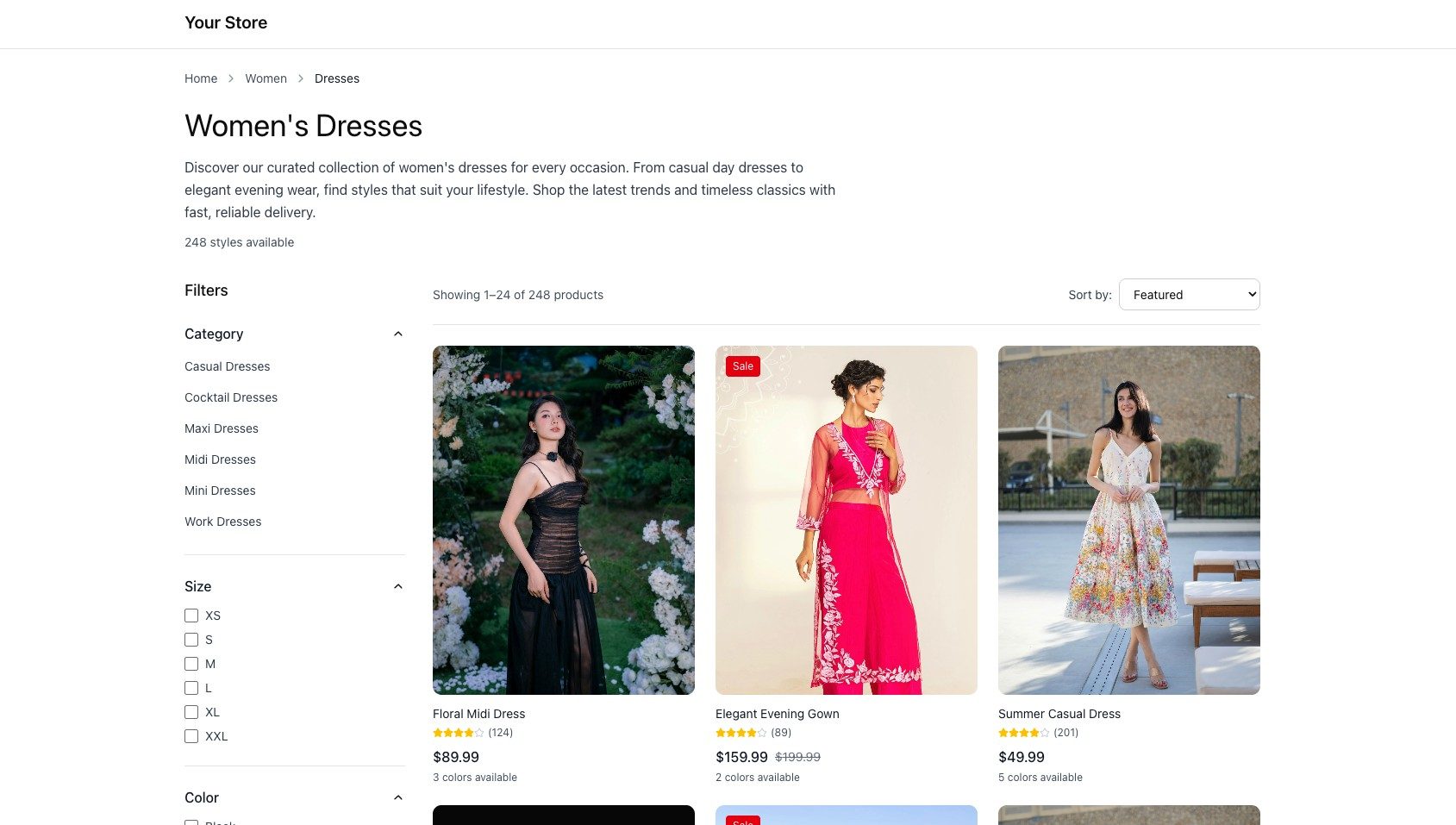
Check out this mockup I quickly ran in Figma Make based on that list!
Product Page SEO
Manually writing unique, long-form descriptions for every product is rarely realistic, and it is often unnecessary.
At scale, strong product page SEO relies less on editorial prose and more on aggregated value signals that differentiate products in meaningful ways.
Clear evidence of usefulness, relevance, and specificity can look like simple additions, such as:
- Clear product name (H1) that reflects how users actually search, not internal SKUs or overly creative naming
- Concise value-focused summary near the top that highlights key benefits, use cases, or differentiators
- High-quality product imagery with multiple angles, zoom, and descriptive alt context
- Prominent pricing, availability, and delivery information to reduce friction and uncertainty
- Structured specifications and attributes (size, material, dimensions, compatibility, etc.) presented in a scannable format
- Short, purposeful product description that supports understanding rather than repeating specifications
- FAQs based on real customer questions to address objections and long-tail search intent
- Reviews and user-generated content to add trust, originality, and differentiation at scale
- Clear internal links back to the parent category and related products to reinforce context and navigation
- Consistent product structured data (price, availability, reviews) aligned with on-page content
From an SEO perspective, this approach also reduces duplication risk. While product descriptions may be similar across ranges, the surrounding signals, attributes, reviews, imagery, and structured data help create differentiation without requiring thousands of unique words.
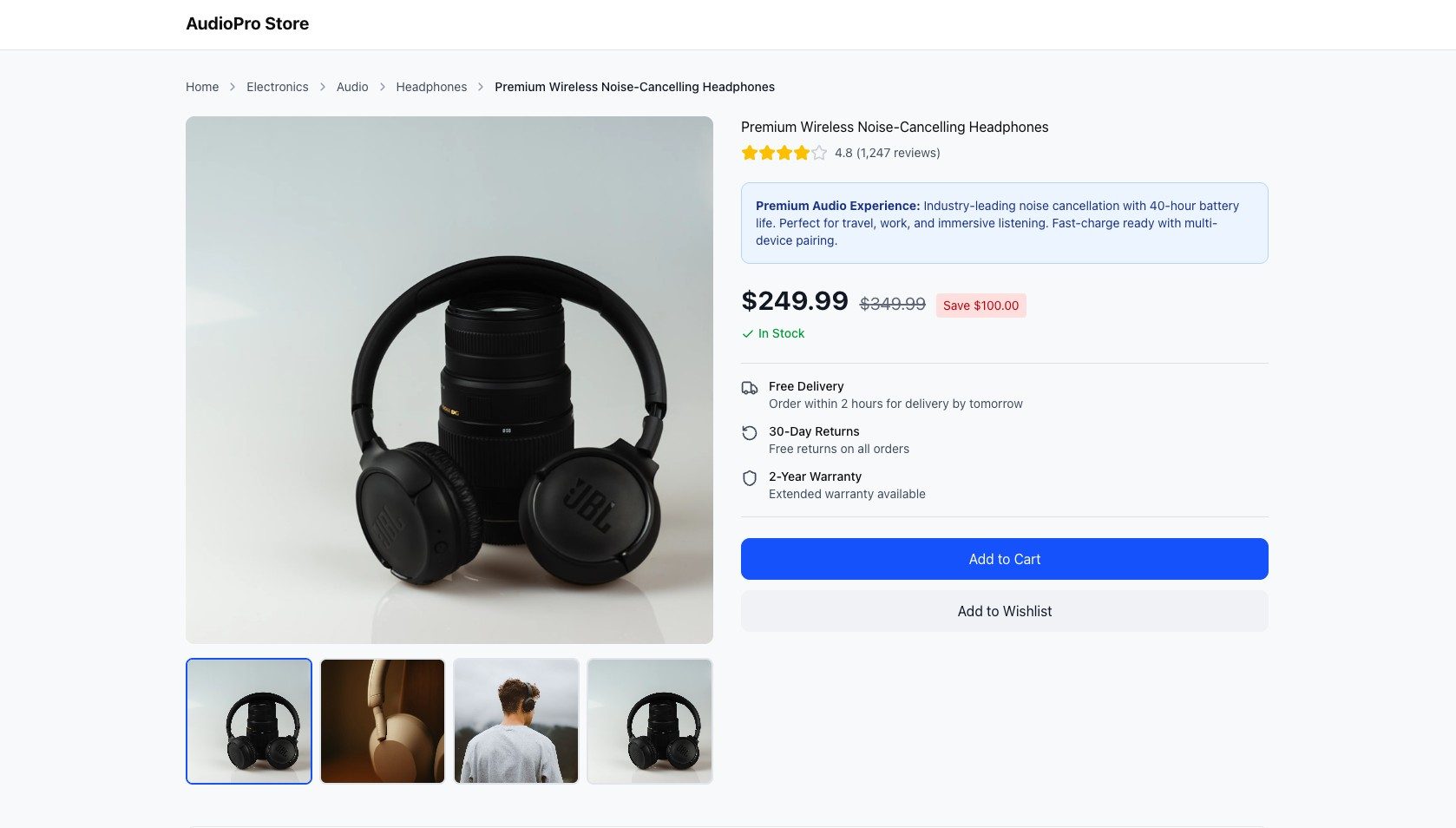
Again, I copied and pasted the recommendations list in Figma to help me draft up a simple illustration of what it looks like in a real setting.
Structured Data, Rich Results & Search Appearance
Structured data is not a ranking shortcut, but it plays a critical role in how products are understood and displayed in search results.
For eCommerce sites, structured data helps Google:
- Interpret product attributes accurately
- Display enhanced listings (price, availability, ratings)
Reinforce category and breadcrumb relationships
Key implementations typically include:
- Product schema for price, availability, condition, and identifiers
- Review and rating markup to support social proof in search results
- Breadcrumb schema to reinforce site hierarchy and context
Free Listings via Google Merchant Center
One area many eCommerce SEO strategies underutilise is Google Merchant Center free listings.
Free listings allow eligible products to appear across Google surfaces such as:
- The Shopping tab
- Google Search (product-rich results)
- Google Images
When implemented correctly, they:
- Increase product exposure without additional ad spend
- Reinforce Google’s understanding of your product catalogue
- Complement organic product and category rankings
However, Merchant Center should not be treated as a “set and forget” channel. Feed quality matters. Ensure you’ve connected your shop platform with Google Merchant Center correctly, allowing all changes to product availability, sales, and other changes to your catalogue to inform this channel and update listings correctly.
Content That Supports Your Online Store
Blog content should strengthen commercial pages, not distract from them.
One of the most common mistakes in eCommerce SEO is treating blogs as a parallel growth channel rather than a supporting layer. When content exists in isolation, it may drive traffic but fail to contribute meaningfully to revenue.
High-performing eCommerce content typically aligns closely with purchase intent and decision-making, including:
- Buying guides that help users choose between options
- Product comparisons that address common objections
- Curated collections for specific use cases or audiences
- Educational content that resolves pre-purchase friction
The strategic value of this content lies in how it is linked and positioned. When informational content reinforces categories and products through internal linking and contextual relevance, it transfers authority where it matters most.
Authority, Links & PR for eCommerce Brands
Generic guest posting may work in service-based industries, but it rarely scales or aligns well with product-led businesses. eCommerce brands operate in a fundamentally different environment — one where products, partnerships, and commercial activity naturally create opportunities for visibility beyond the website itself.
Retailers have structural advantages that many service businesses do not. New product releases, collaborations, seasonal campaigns, sales cycles, and catalogue scale all lend themselves to story-led content and digital PR, which can support SEO while also functioning as a channel in its own right.
Effective approaches often include:
- Product-led PR campaigns tied to launches, trends, proprietary data, or seasonal insights
- Supplier, manufacturer, and brand relationships that naturally support citation and coverage
- Partnerships and collaborations that extend beyond SEO and create shared visibility
- Digital assets such as guides, datasets, tools, or collections that provide genuine reference value
I’d recommend starting with existing relationships. Provide partners with a ready-to-use content snippet or case study they can publish or reference on their websites and other channels.
Then look at engaging PR and marketing specialists to help allocate a budget and execute a strategy that aligns with your brand.
And Finally, Measure Your Success
Contemporary eCommerce buying behaviour has grown more complex and multi-channel, and this directly impacts how SEO’s contribution should be understood. According to the Australia & New Zealand Commerce Report 2025, online shoppers now use an average of 4.8 distinct touchpoints to discover and evaluate products — including organic search, retailer content, personal connections, social media, and other sources — before purchase decisions are made.
This behaviour means that organic search rarely functions in isolation. Customers may encounter a product via SEO early in their journey, later return via paid media or direct channels, compare options on marketplaces or social feeds, and only convert on a final visit. Traditional last-click attribution models can therefore systematically under-credit SEO’s role, even when it has meaningfully shaped awareness, evaluation, and demand capture across multiple touchpoints.
Framing SEO success in this broader context, one where visibility, engagement, and influence span channels, better reflects its true commercial contribution to total revenue rather than just last-click conversions.
In practice, this means measuring success less by which channel “got the sale” and more by whether total revenue, repeat purchase behaviour, and category-level performance are improving over time. If organic search is increasing qualified traffic, supporting conversions across other channels, and reducing reliance on paid media to capture demand, then SEO is doing its job.
What Hasn’t Been Covered Here, But Still Matters
This guide has focused on the structural and strategic foundations of eCommerce SEO. However, search performance does not exist in a vacuum. Several adjacent factors materially influence how SEO performs. For completeness, it is worth acknowledging the following:
- Email marketing and owned audiences
Email remains one of the strongest channels for repeat purchases, promotions, and demand reactivation. Strong SEO feeds email acquisition, and strong email performance improves branded search and return visits.
- Paid media as a demand amplifier, not a crutch
Paid search and social often work best when SEO is already capturing and shaping demand. When SEO improves category clarity and product relevance, paid campaigns tend to convert more efficiently.
- Brand voice, messaging, and identity
Clear positioning, consistent tone, and recognisable brand identity directly influence click-through rates, trust, and conversion — all of which affect SEO outcomes indirectly.
- Transparency around production, sustainability, and values
Modern buyers increasingly seek reassurance beyond price. Clear information about sourcing, manufacturing, sustainability efforts, and business values supports both search visibility and conversion, particularly during the evaluation stage.
- Convenience and fulfilment experience
Shipping costs, delivery speed, returns policies, and checkout friction all shape engagement signals. Poor fulfilment experiences can undermine even the strongest organic visibility.
- Value-seeking and evolving customer behaviour
As cost sensitivity and comparison behaviour increase, content, categories, and offers must evolve. SEO strategies that fail to adapt to changing expectations often stagnate.
- Memorable branding and branded search demand
A distinctive brand or product name reduces reliance on generic keywords over time. Growth in branded search is often a leading indicator that SEO and broader marketing are working together.
- Review-led searches and reputation management
Searches such as “[brand name] reviews” or “[product name] reviews” are common decision points. Having a dedicated reviews or testimonials page, and managing review responses, supports trust and conversion.
- System alignment between website and POS
SEO and UX suffer when stock levels, pricing, sale periods, or shipping calculations are inconsistent across systems. Linking POS, inventory, and website data reduces friction and protects trust.
- Ease of access to customer support
Clear support pathways, FAQs, and contact options reduce hesitation and support long-tail search intent tied to reassurance and problem-solving.
eCommerce SEO Is a System
As this guide has outlined, sustainable SEO performance in eCommerce depends on decisions that span far beyond keywords and content. Platform constraints, site architecture, category structure, product presentation, inventory management, and cross-channel marketing all shape how organic search can perform as a revenue driver.
The brands that succeed with SEO are not necessarily those producing the most content or chasing the most keywords. They are the ones that:
- Reduce structural friction before increasing output
- Invest in category and product foundations that can scale
- Align SEO with commercial priorities, not vanity metrics
- And measure success through total business impact, not isolated channel attribution
When SEO is approached this way, it becomes less volatile and more compounding. Done correctly, it is one of the few channels capable of delivering durable, cross-channel revenue growth.
Love chatting about SEO? Me too! Contact us today for a genuine conversation about SEO.