Google Can Finally Show You Your AI Search Visibility
For the last two years, SEO has carried a blind spot we could not fill with our own data: whether our pages appear when Google answers a search with AI, and how often.
We have had every reason to care about the answer. Across the major clickstream datasets from SparkToro and Datos, roughly 58% of Google searches now end without a click to the open web, and that share climbs when an AI Overview sits at the top of the page. The independent click-through studies tell the same story from different angles. Ahrefs, analysing 300,000 keywords, found a 34.5% drop in click-through for the number-one organic result when an AI Overview is present. Amsive, across 700,000 keywords in five industries, measured an average decline of 15.49%, deepening to nearly 20% for non-branded terms and 27% for pages ranking below the top three. Seer Interactive tracked organic click-through on AI Overview queries falling from 1.76% to 0.61% year on year, a drop of around 61%.
Those figures disagree because each study samples different keywords and query types, so no single number should be treated as the truth. The direction is unanimous across every analysis: when AI answers the question on the results page, fewer people click through to find it themselves. That is the backdrop to Google’s announcement last week, and it is why a fairly modest first release matters more than it looks.
Watch On YouTube
What Google Actually Launched
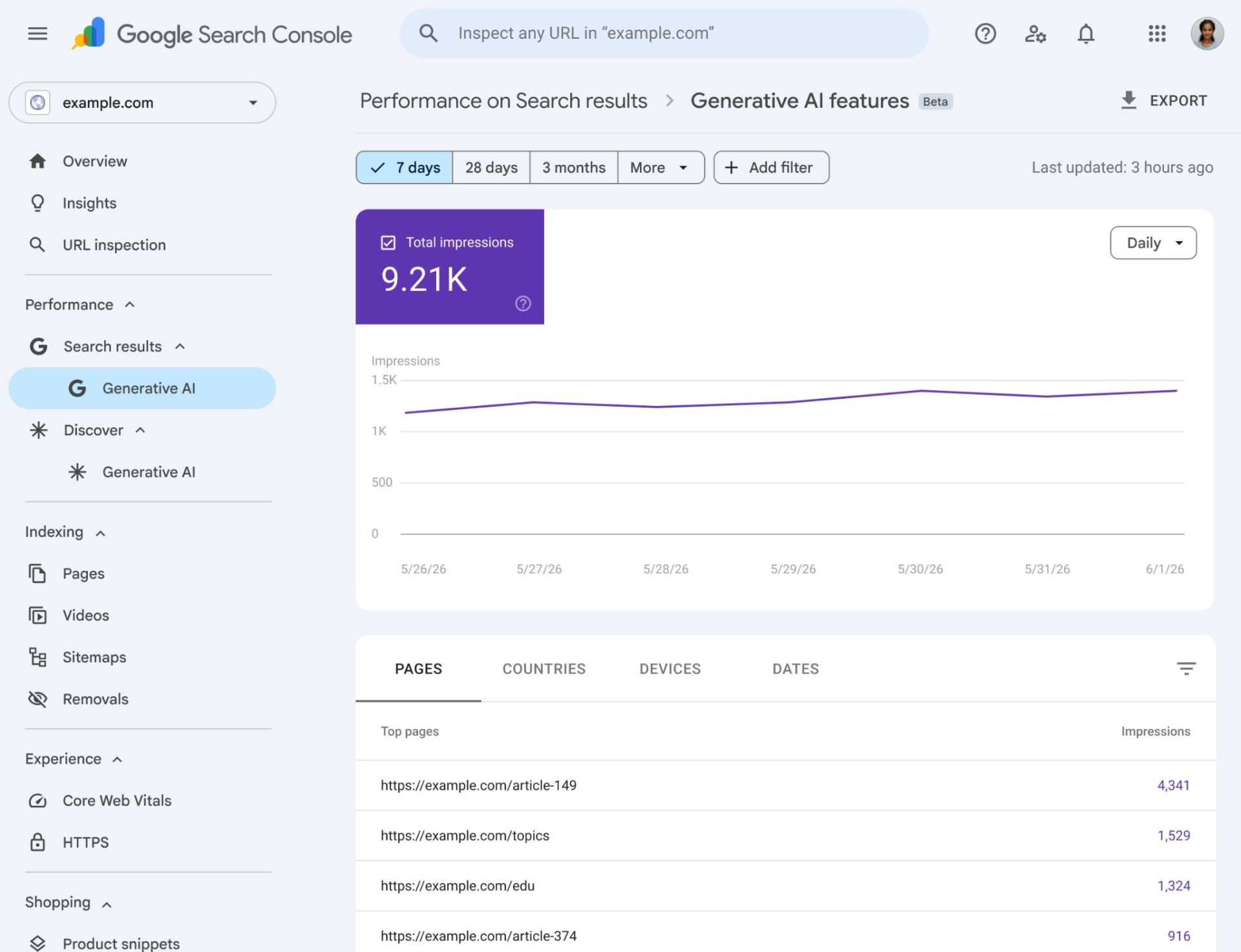
On 3 June 2026, Google announced that they’re adding a generative AI performance report to Search Console.
It shows how your pages appear inside Google’s AI features, broken down by page, country, device and date. For the first time, the numbers describing your AI visibility come directly from Google, rather than from a third-party estimate or an SEO’s own modelling.
The trade-off: The report shows impressions only. There are no clicks, no click-through rate, no average position, and no query data, which is precisely the information the standard performance report already gives you for ordinary search.
So it answers one question, whether you are appearing in AI search, and leaves the more valuable one, what that appearance is worth in traffic, unanswered for now. Google has said more metrics may follow over time.
There is also a quirk in how impressions are counted that is worth understanding before you read too much into early numbers. AI Overviews have historically assigned position 1 to every URL within them, while AI Mode assigns position based on where the link actually appears in the response. Google’s John Mueller confirmed in January that a URL appearing in both an AI Overview and a normal blue link on the same page counts as a single impression, not two. The report measures presence, not prominence, and not yet the value of that presence.
The report is in beta, released first to a limited set of accounts in the UK, and Google will expand from there with no firm global date. For my own site and my clients’, there is no telling exactly when it lands, and my realistic expectation is somewhere before the end of the year. If it has not shown up in your account, nothing is broken, and the underlying data is still being counted inside your overall totals.
Why A Visibility Report Is Worth The Wait
The scale of AI search is what moves this from a curiosity to something you plan around. By BrightEdge’s measurement over the year to February 2026, AI Overviews now trigger on close to 48% of tracked queries, up from around 30% a year earlier. Other trackers put the figure lower, nearer 20%, and the gap comes down to which keywords each study samples. Informational queries trigger Overviews far more often than transactional or navigational ones. For local intent specifically, Overviews still appear on only about 7% of searches, which is genuine breathing room for service businesses that live on “near me” queries.
The user numbers are harder to argue with. At Google I/O in May, the company put AI Overviews at 2.5 billion monthly users, and AI Mode, the conversational interface that behaves much like ChatGPT, at more than a billion, with its query volume more than doubling each quarter. Gartner expects traditional search volume to fall by a quarter by the end of 2026 as people lean on AI answers. Whatever your exact exposure, this is a large and growing channel, and until last week we were measuring our place in it with borrowed instruments.
The Click Data Is Also A Strategy Signal
Read closely, the CTR studies do more than confirm the decline. They show where the opportunity has moved. Amsive’s data found that branded queries are far more resilient: only 4.79% of branded searches triggered an AI Overview, and when they did, click-through rose by 18.68%. Seer Interactive found that pages cited in an AI Overview earned roughly 35% more organic clicks and 91% more paid clicks than pages that were not cited.
Two conclusions follow:
- First, being referenced inside the AI answer has become its own competitive position, distinct from ranking in the links beneath it. There is heavy crossover between the pages that rank in the traditional top ten and the pages Google cites in its Overviews, so the foundations overlap, and citation is increasingly the thing worth winning.
- Second, brand strength is a measurable hedge against the decline in clicks rather than a soft aspiration. The searches least disrupted by AI are those where people already know the name they are typing.
The Opt-Out Toggle, And Who It Is For
Alongside the report, Google introduced an opt-out toggle in Search Console that removes your content from AI Overviews and AI Mode. It takes effect from 17 June, and Google has confirmed it is not used as a ranking signal, so opting out does not cost you position in ordinary search.
For the overwhelming majority of businesses, switching it on works against you, because it removes you from the visibility you are trying to build and measure. A small number of publishers have legitimate reasons to keep their content out of AI features. Most owners and marketers should leave it on.
Google’s Own Position on AEO: It Is Still SEO
The most useful guidance arrived a few weeks before the report. On 15 May, Google published a formal guide, “Optimizing your website for generative AI features on Google Search,” and its central message is direct: for Google Search, optimising for AI is still SEO. The AI features run on the same ranking and quality systems as ordinary search, pulling from the same index, so there is no separate playbook to chase.
It helps to understand why. Google’s AI features use retrieval-augmented generation, which means the AI is grounded in pages Google already ranks and cites, alongside a technique called query fan-out that breaks a single question into several underlying searches. The content that wins is the content that was already retrievable and trustworthy. That is the mechanical reason foundational SEO keeps mattering.
Google also named tactics you can stop paying for. You can ignore llms.txt files, content chunking, rewriting pages specifically for AI crawlers, and bolting on special schema in the hope of preferential treatment. None of it gets special handling inside Google’s AI features. In early June, Google reinforced the point by updating its documentation to name AEO and GEO directly and to give businesses a yardstick for judging vendors: if a provider cannot cite official Google guidance for a recommendation, treat the recommendation as opinion.
I would hold all of this with a measure of healthy scepticism!
Google has been guarded, and at times misleading, with the SEO community before, because it does not want its systems reverse-engineered for loopholes. The honest reading is that AI-exclusive tactics are not necessary today. They are worth understanding and watching, not worth building a strategy around. This is also why AEO has been such a divisive subject at the conferences I have attended over the past year. The room tends to split into those who dismiss it outright, those who have gone all in, and a sensible middle that treats it as an extension of work they already do well.
How To Measure While You Wait
The report is not the only signal available, and for most Australian businesses it will not arrive for a while. In the meantime, third-party AI visibility trackers give a reasonable estimate of how often you are cited.
GA4 can surface referral clicks coming from alternative AI chats such as ChatGPT and Claude, which is the closest proxy we have for the traffic side the new report leaves out. And nothing replaces a manual spot-check: run your priority queries through AI Overviews and AI Mode and see whether you are cited, and which competitors are. None of these is perfect, and that imperfection is exactly the problem Google’s first-party report begins to solve.
What This Changes For How We Work
The practical shift is that guesswork starts giving way to evidence. Once the report reaches your account, you can watch which pages earn AI impressions, test changes against that signal, and learn what genuinely moves your AI visibility rather than inferring it from third-party tools. For a discipline that has spent two years theorising about AI search, a first-party number to test against is a real upgrade.
What you do with it stays grounded in fundamentals, and the data backs each one. Common themes across all AEO chatter include:
- Make the site technically accessible to both people and crawlers. If Google cannot reach and render your pages, nothing downstream matters, and the citation crossover with traditional rankings means access is the price of entry.
- Write human-first content that speaks to a specific audience and earns trust through real expertise and experience. The pages most likely to be cited are the ones only you could have written, which is also how Google frames it in its own guide.
- Invest in brand deliberately. The CTR data makes the case more plainly than any argument: branded queries are the one category where AI Overviews lift clicks rather than suppress them, so brand building compounds straight into search performance.
- Treat digital PR as part of the strategy. Being a genuine authority in your field and contributing a fresh point of view rather than recycling the copy that already saturates search makes you more likely to be cited by AI and more distinct from competitors.
Where This Leaves Us
Google’s announcement is an early, limited first step toward measuring AI search, and a genuine one. We have moved from a world of pure inference and third-party estimates toward one with a first-party visibility report, however modest its first release may be.
The metrics will (hopefully) deepen, the rollout will reach Australia, and the businesses that treat AI citation as a real objective, built on solid SEO and a strong brand, will be the ones with data to act on when it does.
I have recorded a video walking through all of this in plain terms, embedded above. The announcement and the most useful studies are linked below.
Sources and further reading
- Google’s announcement, Search Console generative AI performance reports: https://developers.google.com/search/blog/2026/06/gen-ai-performance-reports
- Google’s guide, optimising your website for generative AI features: https://developers.google.com/search/docs/fundamentals/ai-optimization-guide
- Google’s announcement of that guide: https://developers.google.com/search/blog/2026/05/a-new-resource-for-optimizing
- Search Engine Journal, Google calling AEO and GEO “still SEO”: https://www.searchenginejournal.com/googles-new-ai-search-guide-calls-aeo-and-geo-still-seo/575026/
- Search Engine Land, the Ahrefs and Amsive click-through studies: https://searchengineland.com/google-ai-overviews-hurt-click-through-rates-454428
- Amsive, AI Overviews CTR research (branded vs non-branded): https://www.amsive.com/insights/seo/google-ai-overviews-new-research-reveals-how-to-navigate-click-drop-off/
- IDEAVA, study-by-study CTR breakdown including Seer Interactive: https://ideava.com/insights/ai-overviews-ctr-decline/
- Google I/O 2026, the latest direction for AI in Search: https://blog.google/products-and-platforms/products/search/search-io-2026/