Why Your Business Disappeared from Google

A few years ago, SEO felt a whole lot easier. It seemed that you could search for your business category in your city and find yourself on page one simply by having a professionally designed website or by being around for a while.
Encouraging Google reviews, investing in SEO, and getting a boost of local directory listings were sustainable long enough that marketing budget cuts trimmed the ongoing SEO retainer, digital PR, and other digital presence investments without much impact on hot leads coming through the website for another year or two.
Now you search the same terms and scroll through pages of results looking for your business. Nothing. Or worse! You find yourself buried somewhere on page three or four, behind competitors you’ve never heard of.
It can feel like you’re starting from scratch again, staring dead in the eye of a 5-figure new website and actually having to go through with SEO agency pitch calls, hoping it won’t take years to get back to where you were.
Your business isn’t showing up on Google the way it used to, which is a common new pain point for many businesses that’ve reached out to us in recent months. Let’s dive into the why.
What Actually Happened
The Google you were ranking on three or four years ago is a genuinely different product from the one operating today.
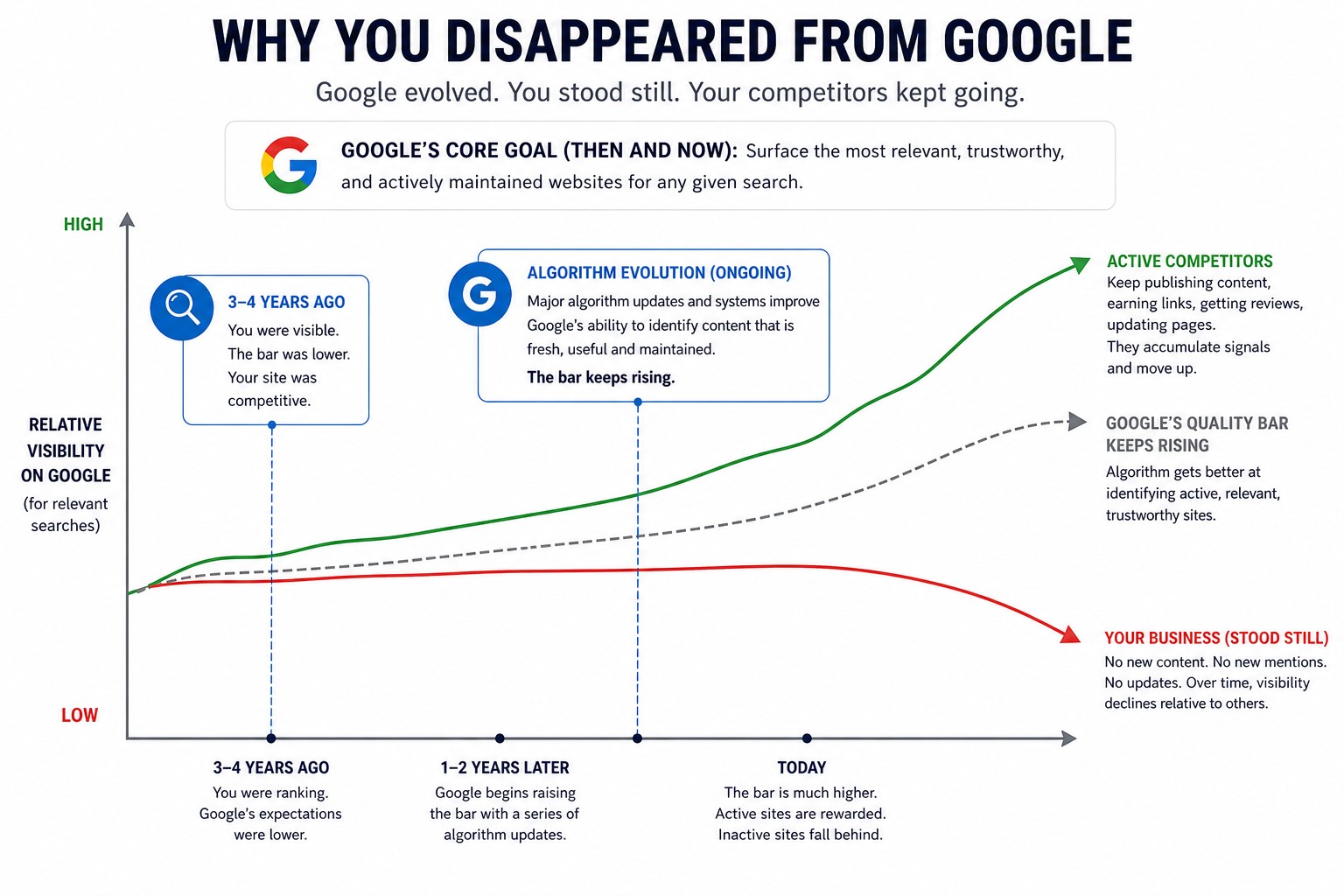
Over the past few years, Google has rolled out a significant series of algorithm changes focused on one core goal: surfacing the most relevant, trustworthy, and actively maintained websites for any given search. As Google users ourselves, we find that reasonable, but the knock-on effect on businesses that stepped back from their online presence has been real.
In simple terms, Google got much better at identifying sites that had gone quiet. Sites that stopped publishing new content. Sites that stopped earning mentions and links from other places on the web. Sites where nothing had changed in twelve or eighteen months. And over time, it started to favour sites that were clearly still active = businesses that were investing in their presence, building reviews, updating their pages, and adding new content.
This isn’t a penalty in the traditional sense. Nobody at Google pushed a button and removed your listing. What happened was more gradual: while your site stood still, the algorithm raised the bar, and your competitors, who kept going quietly, accumulated the signals that now push them ahead of you.
Google Looks Different Now, Too
Even setting aside the algorithm changes, the search results page itself has changed significantly!
A few years ago, if you ranked in position one or two for a keyword, you were effectively the first thing a potential customer saw. Today, that same search might show two or three paid ads at the top, then a large map pack with three local businesses, their star ratings, review counts, and photos — all before a single organic result appears.
Here’s the first page of search results for ‘seo agency’ from a Gold Coast IP in 2026:
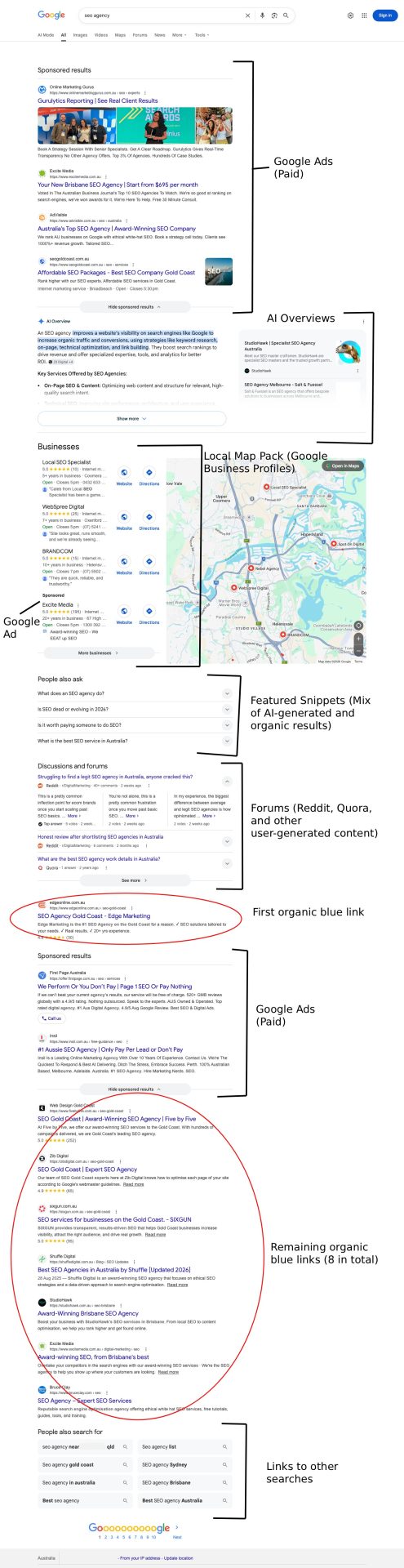
On top of that, Google now generates AI-written summaries at the top of some search results, answering common questions directly without the user needing to click anywhere (in SEO land, we call it zero-click search).
AI Overviews have also continued to evolve in 2025 and 2026 to drive users away from search into ‘AI Mode’ as part of Google’s AI Mode rollout, which was meant to rival ChatGPT and other LLMs. Again, all under the same principles: giving users access to the most relevant, up-to-date, and accessible content that serves them best.
So, simply being one of the top blue links in Google search results is not as ‘achievable’ as it used to be, and it doesn’t directly translate into results either. There is so much more ‘real estate’ to target with your SEO strategy, and therefore more emphasis on things like your Google Business Profile, fresh and frequent content additions to your website, and competitor gap analysis.
Why Dormant Sites Drift
Investing in SEO has never been encouraged as a one-time set-up. Ongoing work is ALWAYS required, as zero maintenance will absolutely see either a steep or gradual decline in your website’s visibility.
Think of it like this. Every piece of new content you publish is a signal to Google that your site is active and relevant. Every new review you earn tells Google that real customers are still engaging with your business. Every mention of your business on another website is a small vote of credibility. Every update to your Google Business Profile is evidence that the information is up to date.
When those signals stop, Google starts to weigh your business less heavily against competitors who are still generating them. Meanwhile, those competitors are compounding. Every month they publish content, earn reviews, and build links, they extend their lead a little further.
This is the compounding nature of SEO drift, and it’s why the gap can feel so large when you come back to it. It’s not that everything you built was wasted. It’s that the playing field shifted while you were standing still, and the businesses that kept moving gained ground they now hold.
The Good News: You’re Not Starting From Scratch
An existing domain with history is a meaningful asset.
A website that has been live for five or six years has things that a brand-new website doesn’t. It has indexed pages. It has backlinks from other sites that were earned over time. It has a track record with Google. It may have old content that still earns occasional traffic or sits just outside the top results and needs relatively little work to climb.
Domain age and history are genuine signals of credibility, and they give a recovery strategy a foundation to build on that simply doesn’t exist for someone starting fresh.
Recovery is a different process from starting from scratch. If you’re simply recovering from dormancy, you’ll find it easier to start ranking content again and generating more traffic to the website.
That said, realistic expectations matter here. Recovery isn’t instant. Google needs to see consistent signals over time before it shifts rankings, and the timeline depends on how competitive your category is, how much ground you’ve lost, and how focused your strategy is.
But momentum builds, and businesses that commit to it consistently are often surprised by how quickly things start to move.
NOTE: If your website has been hacked, filled with spam, or had its security measures lapse, causing issues or penalties from Google, it will take a little longer and require a little more work to overcome. You’ll be building trust, almost like brand new again.
Where to Focus First
1. Start With an Audit
Before you change anything, understand what you actually have.
If your website was developed in the last 3-4 years, it likely can be repurposed. Consider:
- Photos – any original photos/videos you can keep
- Pages – service pages, location pages, etc., that still serve their purpose
- Free resources – calculators, guides, blogs, etc., that have been a useful tool for your brand
Some of your existing pages may be in better shape than you think. Some may need updating rather than replacing. Knowing what you’re working with prevents unnecessary work and protects anything that’s still performing.
Getting a full SEO audit may even bridge the gap between what you and AI tools can identify on the surface and what needs to be fixed more deeply.
Additionally, have some grace around how the business has evolved over the years. Your website often no longer reflects your brand or offerings accurately after a few years without updates. Zooming out and starting with a look at your brand identity is always recommended before commencing SEO work or website refreshes.
Then you can audit your website accurately.
2. Revive Existing Content First
If you have existing content, such as blog posts, service pages, and location pages, updating and strengthening it will often produce faster results than publishing brand-new content.
Google already knows these pages exist. Giving them a meaningful refresh signals activity and can re-engage rankings that have slipped.
You can revive this content with:
- Written copy refresh or rewrite
- Page layout changes – rearranging content locations in order of priority, removing sections that no longer serve the user, or rearranging content into different layouts (such as accordions, tabs, drop-downs, etc.)
- New original images and videos
- New on-page features such as Google Review ratings, internal links, external links, buttons, testimonials, award badges, quotes, author boxes, etc.
Remember that fresh, original content is highly valued.
3. Google Business Profile Refresh
If your GBP has been neglected, this is one of the highest-impact things you can do in the shortest time commitment.
Accurate categories, a complete service list, updated photos, and a plan to consistently earn new reviews will significantly improve your local visibility, often regardless of what’s happening with your website rankings.
Take note of what your successful competitors have done with their profiles. Consider:
- Their primary and secondary service categories
- If they have an address or not
- How many reviews do they have
- How they’ve responded to negative reviews
- What type of photos have they uploaded
- How frequently do they use the post function
Just understand that the local maps section on Google’s SERPs is highly volatile due to the nature of local search. If you’re looking for a plumber near you in Cararra, you’ll be delivered completely different results if you’re searching from home or the beach.
4. Rebuild Your Review Velocity
Review count and recency are visible signals to both Google and potential customers before anyone clicks. If your last review was two years ago, that’s working against you in the local pack.
A simple, consistent process for asking satisfied customers to leave a review is worth more than most technical SEO fixes.
I’d recommend starting by asking:
- Referral partners
- Existing customers/clients
Ensure to respond to every review with a detailed response that adds some more context about your relationship and how you helped them.
5. Start Optimising For One or Two Major Keywords
Trying to rank for everything at once is how businesses end up ranking for nothing in particular.
Get clear on the searches that actually drive enquiries for your business and build your early recovery around them. These keywords are often commercial-intent terms for your service and location, such as:
real estate agency gold coast
air conditioning repairs near me
buy car battery online
You’ll often find that your homepage is the one to rank for your biggest service. For e-commerce, product pages and category pages will often serve you for your major business-driving keyword targeting.
What Happens Next Is Up to You
The businesses that recover their Google visibility aren’t necessarily the ones with the biggest budgets or the longest history. They’re the ones who make a decision, stay consistent, and work with someone who can prioritise the right things at the right time.
If you’ve been wondering why your website isn’t showing up on Google the way it used to, now is a good time to get a clear picture of where you actually stand and make an informed decision about what to do next.
At 5 Twelve, we work with local service businesses across Australia who are in exactly this position. With no lock-in contracts, we offer an honest look at your situation and, if it suits you, a focused strategy to get your visibility back.
Book a free discovery call, and we’ll take a proper look together.