Can I Use AI-Generated Content On My Website?

Yes. You can use AI-generated (or AI-assisted) content on your website, including content you want to rank in Google.
What matters is simply whether the content is genuinely helpful, accurate, and made for people, not primarily made to manipulate search rankings. That is Google’s position, and it’s consistent across their Search Central guidance and spam policies.
Let deep dive in this article!
What Google Actually Cares About
Google’s guidance can be summarised in one line:
AI is not the issue. The issue is content created primarily to manipulate rankings.
Google has explicitly said that using AI-generated content is not against their guidelines, and that their focus is on content quality and usefulness.
They repeat the same principle in Search Essentials: their ranking systems aim to surface helpful, reliable, people-first content, not content created primarily to game search.
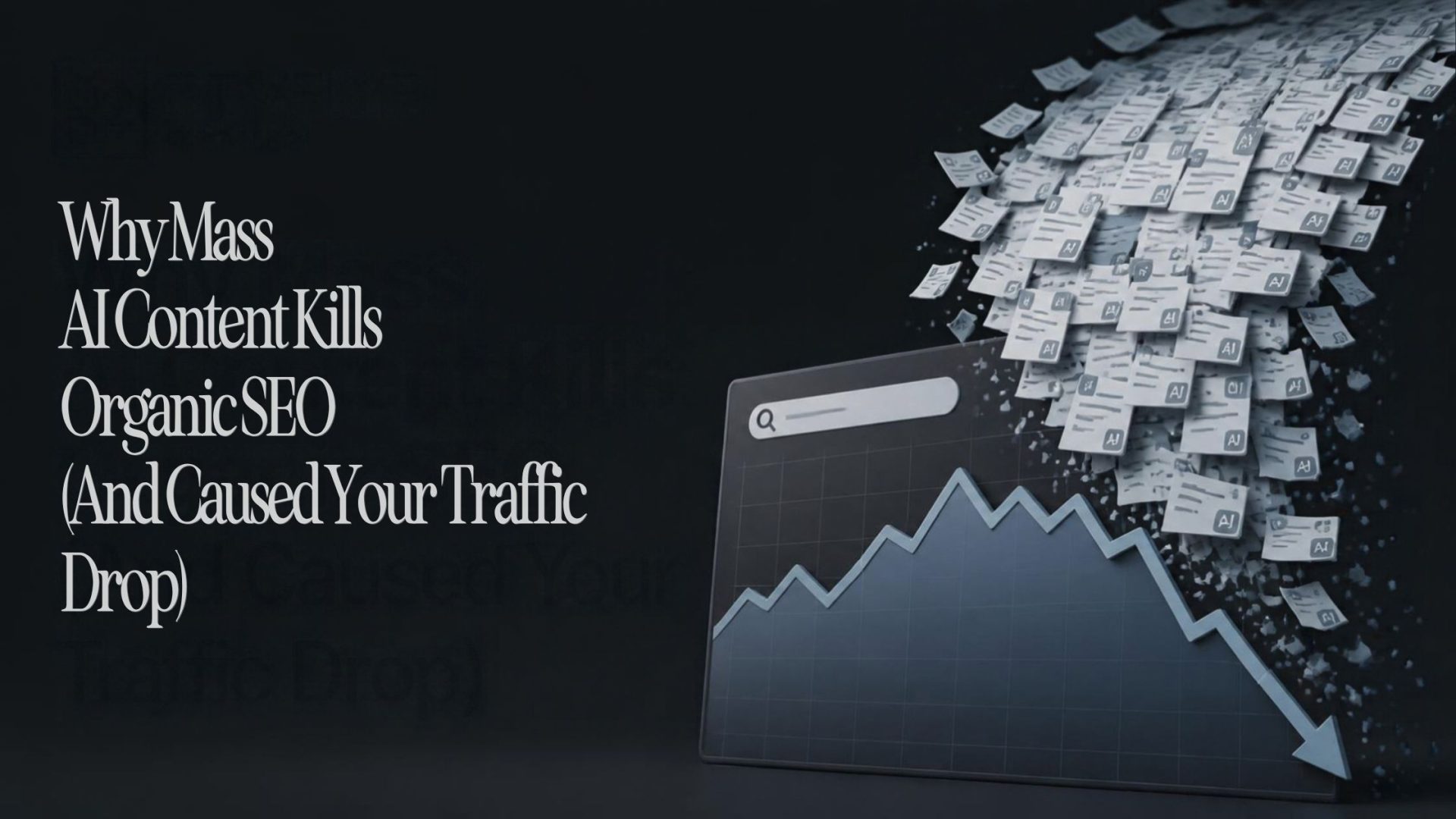
Where it becomes risky is when AI churns out many pages without adding value. Google calls this “scaled content abuse”, and it sits inside their spam policies.
What is AI-Generated Content?
AI-generated content is content produced by a model that predicts text based on patterns it learned during training. Common AI models include ChatGPT, Claude, and Gemini.
“AI content” usually means one of these:
- AI-drafted, human-edited: AI creates a first pass; your team rewrites, validates, adds proof and examples.
- AI-assisted: AI supports outlining, FAQs, summaries, formatting, meta titles and descriptions.
- AI-spun: AI rewrites existing pages to create “new” content without adding substance.
- Scaled AI publishing: lots of pages created quickly, often programmatically, with minimal review.
From an SEO risk perspective, (1) and (2) can be completely sensible. (3) and (4) are where most sites run into quality and spam-policy problems.
Does AI include machine learning?
Most generative AI used for content is machine learning. “AI” is the umbrella term; “machine learning” is one of the key approaches used to build AI systems, and modern large language models are a type of machine learning.
How AI models are created (high-level)
At a high level, models are trained on very large datasets to learn relationships between words and concepts. They then generate text by predicting the next item in a sequence.
For SEO purposes, the key operational point is that AI is good at producing plausible language. It is not inherently good at producing true, current, or commercially safe statements.
That’s why the workflow matters more than the tool.
Does AI-Generated Content Rank in Google?
Yes, AI-generated content can rank in Google. It ranks for the same reasons any content ranks:
- It matches the intent behind the query
- It offers something meaningfully better than what’s already ranking
- It demonstrates trust (accuracy, evidence, transparency)
- It’s internally linked and technically accessible
- It earns attention over time through links, brand signals, and user behaviour
Blogs and articles are where AI-generated content most often underperforms, because the default workflow usually produces a polished version of what already exists on Google.
If your process is “prompt, draft, publish”, the model will typically reshape the dominant ideas it has seen before, then present them in a slightly different structure. The result is a familiar “What is X” article that reads well but adds nothing materially new.
In a competitive SERP, that’s a commodity page. Google already has plenty of competent definitions and summaries, so there’s no clear reason to rank another one.
AI can absolutely speed up research, outlining, and drafting, but it does not automatically create differentiation. Unless your workflow forces original inputs (first-party data, real examples, a clear point of view, expert review, screenshots, case notes, or a decision framework), you tend to publish the same content that’s already ranking, just reworded.
That’s why “does AI content rank?” so often becomes “why didn’t my AI content rank?”. The missing ingredients are still human-led: expertise, proof, specificity, and a reason for the page to exist.
“Can Google Detect AI Content?” Is The Wrong Question
SEOs and their clients alike love asking this question. So much so that AI detectors are increasingly integrated into tools like Ahrefs, Grammarly, and others.
But Google doesn’t need a perfect AI detector to enforce quality. Their systems can identify patterns associated with spam and low-value content, and their spam policies are method-agnostic: the problem is the intent and the outcome, not whether a human or a machine typed the words.
Also, most third-party AI detectors aren’t entirely reliable. They often produce false positives (flagging human writing as AI) and false negatives (missing obvious AI).
If your content governance relies on an AI detector, you’re measuring the wrong thing.
A better internal question is:
Does this content add real value for the target audience, read clearly, and offer fresh insight beyond what’s already ranking?
Where AI Often Is Used On Websites & Why Page Intent Matters
AI is now baked into most content workflows, but not all pages serve the same purpose. When teams apply the same AI drafting approach across the whole site, performance tends to split quickly.
A simple way to think about it is this: some pages are designed to help someone decide, and others are designed to help someone learn. AI can support both, but the standard of proof, specificity and brand accountability change depending on the page type.
If you do not align your workflow with the page’s intent, you end up publishing content that reads fine but does not move users forward or give Google a strong reason to rank it. For example:
- Service pages have commercial intent. They exist to convert website visitors into a conversion. AI can help structure the page and cover common questions, but the content needs real operational detail (what you do, who it’s for, what’s included, how you work, proof, pricing, CTAs, etc.).
- Product pages have transactional intent. AI can help with formatting, feature explanations, FAQs, and comparison tables, but it must not invent specs, compatibility details, warranties, or claims. PLUS, here’s an SEO tip for product pages: more words don’t work for product page performance.
- Blogs and guides have informational intent. They meet their intended audience at the start of their customer journey. AI is very useful for ideation, outlines and first drafts, and AI-written blogs can even rank well with minimal human interaction. BUT this is not recommended for all industries. Finance, medical, legal, and other industries that have a real-world impact on lives should involve a qualified professional at each stage of the content process.
Other pages, such as the About page, Location Pages, and FAQs, typically form part of the customer journey to build trust, establish legitimacy, and provide structured navigation. AI can help with structure and framing, but when it comes to elements like an author bio or delivery & shipping information, a human is almost guaranteed to need to be part of the content creation for accuracy.
AI is known to simply “make up” what it wants when information is missing. Don’t confuse your customers or break trust with inaccurate information.
What Scaled, Low-Value Publishing of AI Content Looks Like
By this point in the article, the key idea should be clear: publishing large volumes of low-value pages (whether written by AI or not) is exactly what Google’s scaled content abuse policy is designed to discourage.
The risk is not “AI content” in isolation. The risk is using AI to produce pages at a scale where you cannot realistically maintain accuracy, usefulness, and differentiation.
In practice, low-value scaling tends to show up in two common formats:
- Programmatic location and service pages that are largely templated, with only the suburb or service name swapped.
- Blog output that repeats the same concepts across dozens of posts, with minimal original insight, proof, or first-hand expertise.
Blogs
Blogs can absolutely be a legitimate SEO growth channel. When there’s a clear strategy behind them, they help you educate the market, build topical authority, and capture high-intent searches earlier in the buying cycle.
But they’re also the easiest format to spam. The failure mode is predictable: instead of publishing a sensible number of genuinely useful articles, some teams push out hundreds of posts at speed using AI prompts. The content reads smoothly, but it tends to be generic, repetitive, and unverified. It does not add anything materially new versus what already ranks.
It’s also where you still see older, riskier tactics resurface, including private blog networks (PBNs). A PBN is a network of websites created primarily to publish content and link back to a “money site” to manipulate rankings. PBNs were a fantastic way to get a backlink from an ‘authoritative website’ to your own for a relatively low cost. AI has now made these networks more susceptible to penalties, and the majority that have flourished over the years are now receiving literally 0 traffic.
Programmatic SEO
Programmatic SEO is simply the practice of producing pages at scale from structured data (for example: services × locations, product attributes, categories, listings). In principle, it can be useful when each page serves a real user need and contains genuinely distinct information. But I have beef with it.
When the output is basically a template with thin variations, the pages don’t add unique value (local proof, specific service coverage, meaningful comparisons, detailed listings, editorial curation), and you end up with a large footprint of pages that Google can treat as low value. When that happens, you often see a broader site-level reassessment and duplicate content flags that affect the entire website’s performance.
I know businesses that have invested tens and hundreds of thousands of dollars into a programmatic SEO strategy for it to reach a sharp peak in performance, then get hit by the next algorithm update – rendering ALLLL of those pages completely redundant and affecting the entire website’s long-term performance.
It takes months to set up, and years to undo the damage. Don’t do this.
Added Extra Example: Directories
(I’m not biased, I swear) Local directories are among the clearest examples of a business model structurally exposed to this issue. They publish enormous numbers of pages (categories, locations, business listings), and much of the content format is inherently templated. That does not automatically make directories “bad”, but it does mean they need strong usefulness signals to avoid looking like a scaled footprint with limited differentiation.
Now, for legal reasons, I won’t name names or make assumptions on the actual performance of these directories, but here are some examples of three directories and their organic search performances according to Ahrefs:
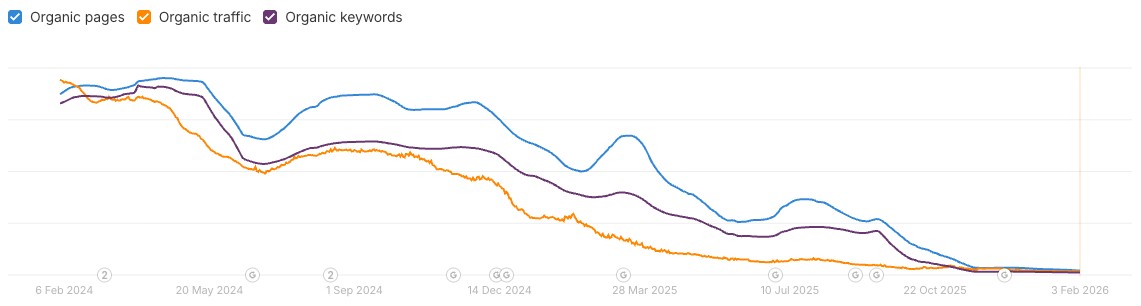
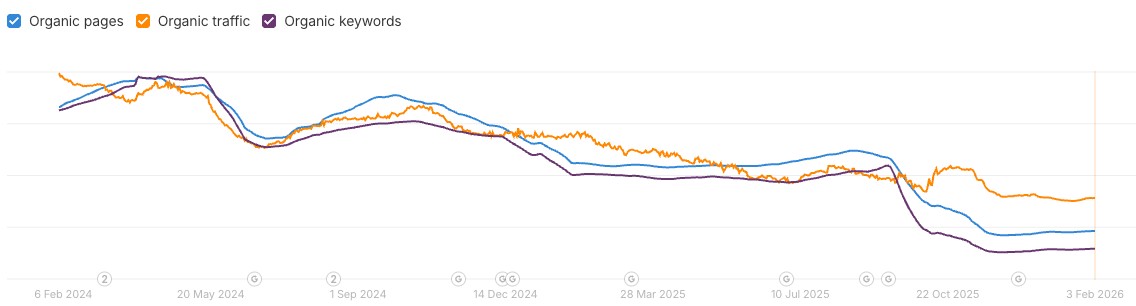
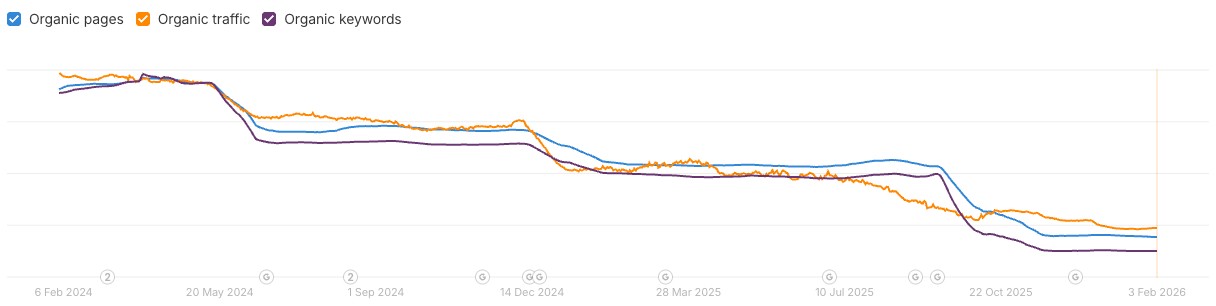
Directories in 2021 and prior used to dominate Google search for local searches. Any query with local intent, such as ‘plumber near me’, ‘electrician southport’, and ‘family lawyer sydney’, would see about a 50/50 split of directories and local businesses.
Unfortunately, Google’s algorithm updates have not only dethroned many of these directories from the first page (NOT ALL, FYI), but some have even appeared to be penalised to the point of no return.
Here’s something funny:
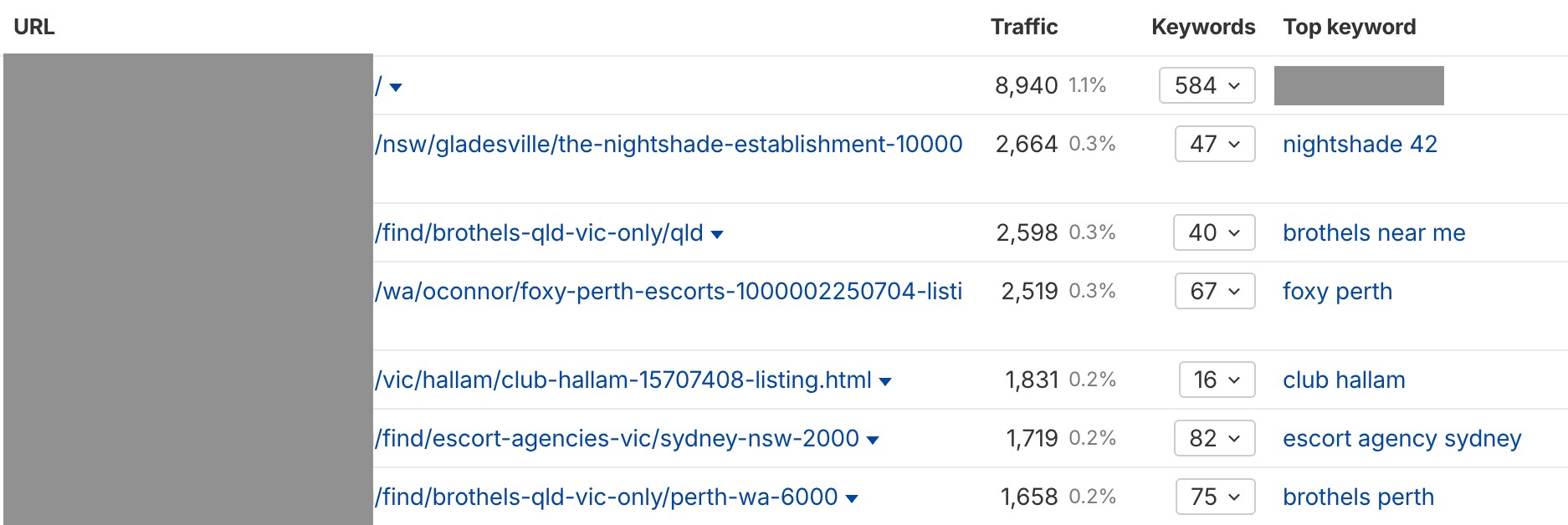
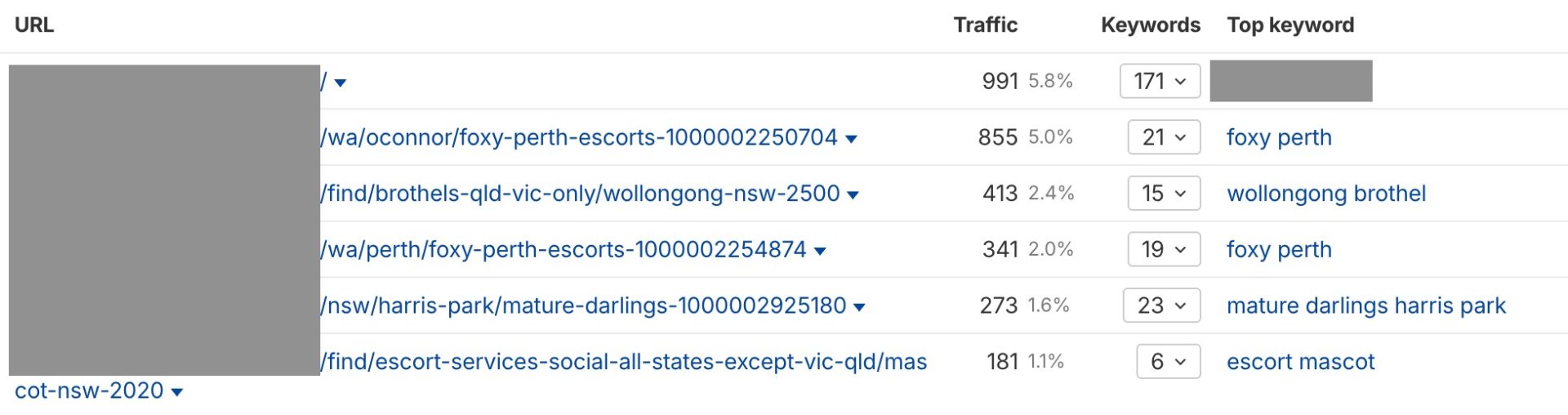
What’s still sustaining a lot of these directories in 2026?
…Local brothel and escort searches.
So Anyways, Use AI At Your Own Discretion
This blog is getting too long, so I won’t be telling you a step-by-step on how to draft content with AI, but just know that you can use AI-generated content on your website. The SEO outcome depends on whether AI helps you publish better content or just more content.
A trade secret of 2026 is that most SEOs and copywriters use AI for content, but the human remains throughout the entire copywriting process. AI is also suited for some content types and not others, and as experts in our fields, we have created our own best practices to support the delivery of our services for long-term, meaningful success of our clients.
Want to talk more about SEO for 2026 and beyond? Book a free discovery call today.